China cuts gasoline, diesel prices for 1st time this year
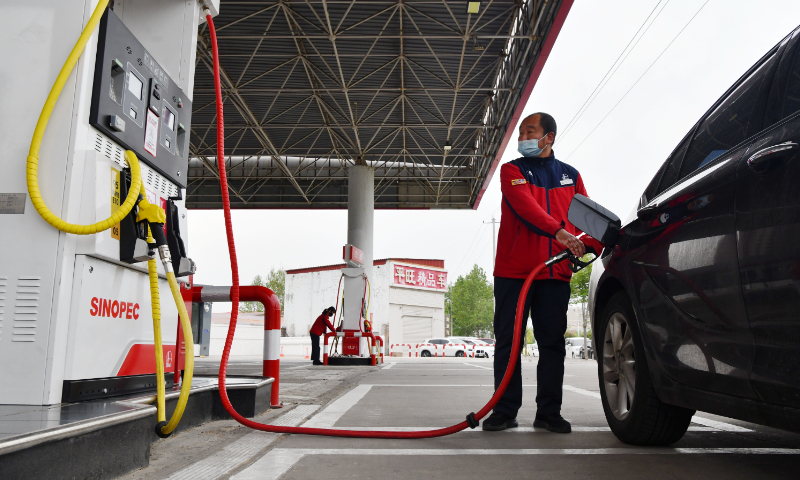
Starting from midnight on April 21, China's retail prices for gasoline and diesel will be reduced by 555 yuan ($81.40) and 530 yuan per ton, respectively, in accordance with changes in international oil prices, the National Development and Reform Commission (NDRC) said on Tuesday.
This round of price adjustments marks the eighth pricing window of this year and also the first reductions since the beginning of this year, China Media Group (CMG) reported.
Nationally, the average equivalent reductions per liter are 0.44 yuan for 92-octane gasoline, 0.46 yuan for 95-octane gasoline, and 0.45 yuan for 0-diesel. Filling a 50-liter tank with 92-octane gasoline will cost 22 yuan less, the CMG report said.
According to the NDRC, since the last price adjustment on April 7, international crude oil prices have experienced sharp fluctuations. After a significant decline in recent days, they rose considerably again on April 20.
However, the average price over the 10 working days prior to the coming adjustment remains lower than that of the 10 working days before the previous adjustment, said the NDRC.
CNPC, Sinopec, CNOOC, and other crude oil processing enterprises should organize the production and transportation of refined oil products to ensure stable market supply and strictly implement the government's pricing policies. Relevant departments in the country should strengthen market supervision and inspection, severely penalize any violations of the policies, and maintain normal market order, said the NDRC.
"This price cut reflects the short-term decline in international crude oil prices, allowing domestic fuel prices to better align with market changes. It will help ease cost pressures on consumers and businesses," Lin Boqiang, director of the China Center for Energy Economics Research at Xiamen University, told the Global Times on Tuesday.
China has stepped in to regulate refined oil prices twice, in a move aimed at shielding the economy and consumers from recent spikes in international crude prices.
Effective from midnight on March 23, the commission adopted regulatory measures on refined oil prices. This marked the first regulatory intervention since the mechanism was introduced in 2013, the Xinhua News Agency reported.
On April 7, the NDRC said that it would continue to regulate refined oil prices to cushion the impact of rising international crude oil prices on the domestic market.
According to an NDRC notice in 2013, in special circumstances -- such as a significant rise in the overall domestic price level, the occurrence of major emergencies, or sharp fluctuations in international oil prices over a short period -- that necessitate adjustments to refined oil product prices, temporary regulatory measures shall be implemented in accordance with the law. Upon approval by the State Council, as requested by the NDRC, price adjustments may be suspended, postponed, or the magnitude of such adjustments reduced.
Lin said that the two changes in oil prices represent precise, moderate, and responsible moves. "Under special circumstances, they serve as an effective 'shock absorber,' safeguarding the stability of market supply while preventing excessively rapid oil price increases from triggering a chain reaction of impacts on downstream industries," the expert noted.
"The escalation of the US-Iran conflict and disruptions to shipping through the Strait of Hormuz pose a significant systemic shock to energy security across Asia. However, we believe that China's energy system has stronger buffering capacity compared with most other Asian economies," Jenny Huang, senior director of Asia-Pacific corporate ratings at Fitch Ratings, said in an analysis sent to the Global Times on Tuesday.
Huang noted that China's crude oil import sources are relatively diversified, and the country maintains substantial commercial inventories and strategic petroleum reserves, which can effectively cushion short-term supply disruptions caused by the conflict.
In addition, major state-owned energy enterprises in the upstream sector bear the responsibility of ensuring supply and stabilizing the market under high oil price environments, thereby further reducing the risks of supply volatility, she said.