China issues guideline to boost 'silver economy' amid aging population

China's State Council, the cabinet, on Monday unveiled a sweeping guideline on promoting the development of the "silver economy," or the elderly care industry, in a bid to actively respond to the aging population and foster new economic growth drivers. China's silver economy could reportedly be worth as much as 30 trillion yuan ($4.18 trillion) by 2035.

The guideline marks the first policy document dedicated to the silver economy, as the country is facing an increasingly aging population. While many foreign media outlets have been hyping China's aging population, experts said that the silver economy could also offer sustainable growth points.

The guideline contains 26 specific measures in four areas, including tackling urgent challenges faced by the elderly, expanding supply of elderly care products and services, and fostering industries with vast potential.

The silver economy is the aggregate of a series of economic activities such as providing products or services to the elderly and preparing for old age, and it has huge potential, according to the guideline. The guideline aims to actively respond to the aging of the population, cultivate new driving forces for economic development, and improve people's quality of life.

Among the main takeaways is a plan to establish 10 high-level silver economy industrial parks in areas such as the Beijing-Tianjin-Hebei region, the Yangtze River Delta and the Guangdong-Hong Kong-Macao Greater Bay Area. The guideline also pledged greater financial support for industrial development, including optimizing the central government budget to support the upgrading of qualified new elderly care service facilities and to promote the use of intelligent equipment.

State-owned enterprises will be encouraged and guided to actively expand businesses related to the silver economy. Private businesses will also be given a full role to play in the silver economy, and unreasonable market access barriers will be removed, according to the guideline.

Currently, the scale of China's silver economy stands at around 7 trillion yuan, about 6 percent of China's total GDP, and the scale could reach 30 trillion yuan by 2035, accounting for about 10 percent of total GDP, according to China Media Group.

Chinese education authorities publish list of 184 primary, secondary school AI education bases

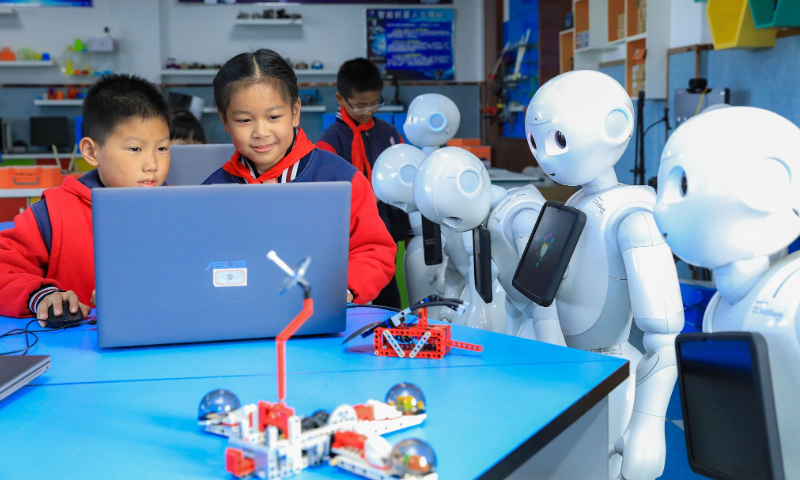
China's Ministry of Education (MOE) on Thursday published a list of 184 primary and secondary school artificial intelligence (AI) education bases across the country including North China's Beijing, Tianjin, and East China's Shanghai, Shandong and Jiangsu provinces, and South China's Guangdong Province, aiming to promote AI education systematically nationwide.

The publicity period lasts from Thursday to January 17. Anyone who has objections can submit relevant information during this period, according to the ministry.

In May 2023, the MOE issued an action plan for deepening the reform of the basic education curriculum, in which it required teaching equipment and usage to be improved, and a group of characteristic high-level science and AI education primary and secondary school bases to be selected.

In Beijing, Tianjin, Shanghai and a few provinces, there are six schools on the list. Some schools started AI education in recent years in the face of the rapid development of AI technology, as a way to encourage more students to gain more knowledge in this sector, and inspire their creative capability to learn how to analyze data and identify patterns based on AI algorithms.

One example is Wenzhou No 22 Senior Middle School in East China's Zhejiang Province , which was founded in 2002. The school has always been at the forefront of information technology in the country, and has been awarded the title of one of the first "100 digital campus demonstration schools" in China.

"AI education has been explored in our school for nearly five years," Ding Die, vice principal of Wenzhou No 22 Senior Middle School, told the Global Times on Thursday.

The school has integrated the curriculum standards related to AI in the fields of information technology and general technology, and has incorporated the course content and practical applications into the school's AI education space. The space integrates the fields of design, teaching, and operation, and is equipped with 3D printers, laser engraving machines, high-end computers and other equipment, according to Ding.

Ding said that the schools will continue improving the relevant AI courses and popularize them among students. The school will also strengthen the connection between students and AI projects in universities, to make students' career planning clearer during their learning process.

Shanghai Luwan Senior High School has also been conducting AI education practice and exploration in recent years. This initiative to establish primary and secondary school AI education bases is highly beneficial to the public, and will be welcomed by parents and students, Zhang Xiaojun, a teacher who tutors students in science and tech classes from this school, told the Global Times on Thursday.

Due to the lack of equipment and teacher resources in some schools, students have limited space to learn more in this sector. With a nationwide drive to build AI bases, students will have the opportunity to delve into real technical content, participating in and gaining knowledge in this field, according to Zhang.

In the school, students are categorized into general courses, advanced courses, and high-level courses specifically designed for a few students. Every student can have access to some basic AI content, such as graphic programming, and using AI to solve practical problems. For advanced courses, they will study specific projects, such as autonomous driving, intelligent logistics, and drone programming, Zhang said.

Zhang said that systematic training and an incentive mechanism will be beneficial to cultivating more teachers in this sector. Ding, the vice principal, also echoed the opinion that it will encourage teachers to take every opportunity to train in AI teaching.

China will carry out further training sessions to boost the scientific competence of primary and secondary school teachers, said a circular jointly issued by the general offices of the MOE, the Chinese Academy of Sciences and the China Association for Science and Technology in July 2023. More than 3,500 teaching staff and science counsellors in primary and secondary schools have participated in the training sessions, which started from mid-July, according to the authorities.

India's intensified probe into Chinese companies casts shadow on its image: experts

India's Enforcement Directorate, the country's financial crime-fighting agency, reportedly conducted probes across 19 locations against what it described as "potential violations of the Prevention of Money Laundering Act" by Chinese-owned companies, reported India Today, in another unscrupulous move targeting Chinese companies.

India's heightened scrutiny of Chinese companies, fueled by purely political motives, is tarnishing the country's image and transforming it into what resembles more of a "graveyard for foreign companies," Chinese experts warned.

The Enforcement Directorate alleged that the corresponding Chinese-owned fintech companies, collaborating with local non-banking financial companies and payment gateways, engaged in unethical lending practices, India Today reported on Tuesday.

The agency seized 13 million rupees ($1.6 million) in cash and several incriminating documents, the report said.

Indian authorities, exercising their right to investigate companies within the country, have increasingly concentrated on Chinese businesses, especially in the past three years, where major companies like Chinese smartphone makers Xiaomi and Vivo have frequently become targets, leading observers to believe in the existence of strong political motives behind these actions, Chinese experts said.

The latest move is  only making the country less favorable for international investors, especially those from China, that have played an important role in creating jobs, paying taxes and contributing to the industry chain's development, Qian Feng, director of the research department at the National Strategy Institute at Tsinghua University, told the Global Times on Wednesday.

India's discriminatory sanctions targeting Chinese companies and their employees include routine financial and tax audits, fines and abrupt spikes in import tariffs, while disregarding these companies' contributions to the local economy, an India-based industry veteran told the Global Times in a recent interview.

The probe came just about a week after the same government department arrested three senior employees working for Vivo's India unit under the provisions of the Prevention of Money Laundering Act in late December.

On December 30, only a few days after the arrest, an Indian trial court ordered the immediate release of the three arrested.

 "The phenomenon of politicizing judicial tools in India is already evident," Qian said, noting that it will have a significant impact on India's touted investment environment, and also affect bilateral economic and trade relations.

Since the border conflict between China and India in June 2020, there has been a noticeable escalation in Indian authorities' hostility toward Chinese companies, including the prohibition of more than 200 Chinese apps, initiating investigations related to taxation and anti-money laundering concerning Chinese businesses, and intensifying the examination of Chinese investments.

If India continues down this path, it will only add another negative aspect to its reputation as a "foreign enterprise graveyard," Qian noted.

Chinese police offer cash reward to hunt down telecom fraud ringleaders in northern Myanmar

Chinese police have offered a reward between 100,000 to 500,000 yuan ($13,958 to $69,793) for information related to each of the 10 key ringleaders from the telecom scam criminal syndicates based in the Kokang region of northern Myanmar, Capitalnews, the WeChat account run by Beijing Daily, reported on Sunday. The police have also vowed to decisively crack down on fraud targeting Chinese citizens.

In response to the grim situation of telecom fraud in northern Myanmar affecting China, Chinese public security departments have successively announced the pursuit of key figures in several telecom fraud criminal syndicate which created a strong deterrent.

Capitalnews learned from China’s Ministry of Public Security that local public security departments in localities including Northeast China’s Liaoning Province, East China’s Fujian Province and Southwest China’s Chongqing Municipality have put 10 key figures including Bai Suocheng, Wei Huairen and Liu Zhengxiang from the telecom scam criminal syndicate in the Kokang region of northern Myanmar on the wanted lists.

For a long time, various criminal syndicates from the Kokang region in northern Myanmar have organized and established criminal dens targeting Chinese citizens. They openly protect these criminal activities with arms, causing extremely serious harm.

In November of this year, Chinese public security authority publicly announced cash reward for four key figures of a family criminal syndicate led by Ming Xuechang. With strong cooperation from all parties in Myanmar, the chief criminal Ming Xuechang committed suicide in fear of crime, and three other individuals including Ming Guoping, Ming Julan and Ming Zhenzhen were apprehended and are being investigated for their criminal activities. They will be severely punished according to the laws.

At the same time, public security authorities in Liaoning, Fujian, Chongqing, and other places found during their investigations that three family criminal syndicates led by Bai Suocheng, Wei Huairen and Liu Zhengxiang, and another criminal syndicate led by Xu Laofa have long been engaged in telecom fraudulent activities targeting Chinese citizens, with huge amounts involved.

Despite highly pressured crackdown by the public security authorities, they have not restrained themselves from the crimes and continued to be involved in serious violent crimes such as intentional homicide, intentional injury and illegal detention. Their criminal facts are clear and there is abundant evidence for their crimes.

To effectively crack down on the telecom fraud related to northern Myanmar and protect the safety of Chinese people’s lives and properties and their legitimate rights and interests, the Dalian City Public Security Bureau in Liaoning has decided to publicly reward anyone who brings information of the whereabouts of Bai Suocheng, Bai Yingcang (also known as Li Yunchen), and Bai Yinglan (also known as Li Mengna). The Quanzhou City Public Security Bureau in Fujian has decided to publicly reward anyone who brings information related to Wei Huairen, Wei Rong (also known as Chen Rong), and Wei Qingsong (also known as Yang Song). The Longyan City Public Security Bureau in Fujian Province has put Liu Zhengxiang, Liu Jiguang (also known as Li Huaguang), and Liu Zhengmao on the wanted list. The Chongqing Municipality Public Security Bureau has put Xu Laofa (also known as Xu Faqi) on the wanted list.

According to Capitalnews, Bai Suocheng was former director of Kokang in Shan State, Myanmar. Besides, Wei Huairen, Liu Zhengxiang and Xu Laofa are all officials in the Kokang region.

The Chinese public security authorities urge the 10 criminal suspects to recognize the situation, stop their criminal activities, and surrender voluntarily to seek lenient punishment. At the same time, Chinese police also hope that all sectors of society and the public will actively report and assist in the capture and arrest of the criminal suspects. For those who provide effective clues and assist in the arrest, the public security authorities will give rewards between 100,000 and 500,000 yuan.

Foodborne disease outbreaks down by 11% since 2021; nationwide reporting network to be built next year: national health official

China's food safety governance has made positive progress with a decrease of 11 percent in the number of foodborne disease outbreaks and a 33.9 percent reduction in the number of related deaths since the beginning of the period covered by the 14th Five-Year Plan (2021-2025), officials from the National Health Commission (NHC) revealed at an event in Beijing on Tuesday during Food Safety Awareness Week.

Cao Xuetao, an official from the NHC, noted at the event that China has implemented a national food safety risk monitoring program, and conducted in-depth analysis of risk monitoring database information. This guides local authorities to release risk warning information and advises the public on rational food procurement and storage.

Li Ning, director of the National Center for Food Safety Risk Assessment, said at the event that in recent years the NHC has established three major monitoring systems: the national foodborne disease monitoring and reporting system, the foodborne disease outbreak monitoring system and the foodborne disease molecular traceability network. These systems play a role in risk monitoring, assessment, and early warning, effectively preventing systemic risks.

In the next step, the commission will guide local authorities to strengthen risk monitoring and assessment and it plans to build a nationwide reporting network for foodborne disease cases in secondary and above public medical institutions by the end of next year, according to Li.

With the help of big data, cloud computing, and other information technologies, the network will improve the multi-point triggered monitoring and early warning model, making regional risk warnings more sensitive and efficient.

Foodborne diseases are a significant global public health issue. The World Health Organization (WHO) estimates that up to 600 million people worldwide fall ill and 420,000 die each year due to consuming contaminated food. To address the challenges posed by foodborne diseases, the WHO recommends that countries strengthen monitoring and early warning systems for foodborne diseases, according to Li.

Li said that according to the foodborne disease monitoring network, from 2010 to 2022, a total of 46,430 foodborne disease outbreaks were reported nationwide (an average of 3,572 per year, among which 1,024 cases were due to mushroom poisoning), with 330,870 cases of illness (an average of 25,452 per year) and 1,679 deaths (an average of 129 per year, among which 70 were caused by mushroom poisoning).

The main places for foodborne disease outbreaks in China were households (50 percent) and catering service establishments (46.3 percent). However, catering service establishments contributed the highest number of illness cases, accounting for about 70 percent of the total, according to Li.

Li noted that people should avoid consuming or picking wild mushrooms, as the main cause of foodborne disease outbreaks in households is the consumption of wild poisonous mushrooms and contamination by pathogenic bacteria.

In terms of catering service establishments, attention should focus on preventing bacterial foodborne diseases, while school cafeterias should pay special attention to the contamination of rice with Bacillus cereus. Nearly 70 percent of Bacillus cereus outbreaks in China are caused by rice and other grain products.

Best in class, China-developed ocean drilling ship set for trial voyage

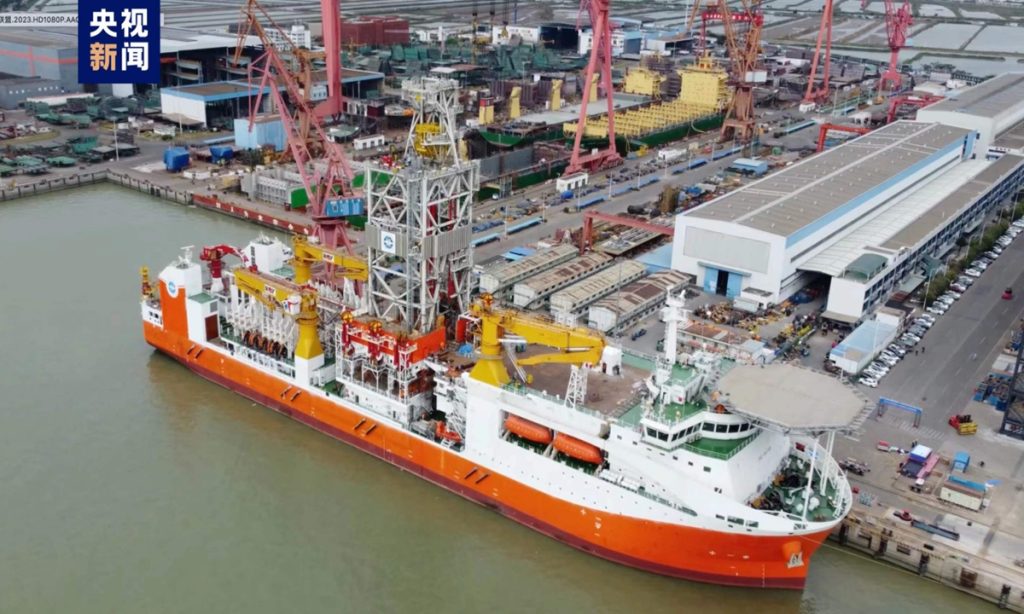
The world's most advanced and China's first domestically developed ocean drilling vessel will commence its maiden voyage on Friday in South China's Guangdong Province, which marks an important step in China's deep-sea exploration capability, China Geological Survey said on Monday.

The vessel, which was developed by China Geological Survey and more than 150 research institutes and companies, was officially named "Mengxiang (Dream)" on Monday. 

Weighing about 33,000 tons, the ship can travel 15,000 nautical miles and operate for 120 days without returning to ports, CCTV News reported. It has the capability of operating in unlimited navigational areas worldwide and the ability to drill as deep as 11,000 meters in the sea.

Possessing deepest drilling depth in the world, the ship has the world's largest shipboard laboratory with more than 3,000 square meters, including nine major laboratories covering marine science, microbiology, and paleomagnetism. It integrates key technologies such as digital twinning to achieve comprehensive monitoring of drilling and mining operations and intelligent collaboration in scientific experiments.

Currently undergoing preparations at the dock in Nansha district of the city of Guangzhou, "Mengxiang" will set sail on Friday to complete its first trial voyage mission according to an official schedule. With construction beginning on November 30 2021, it is expected to be fully completed in 2024.

After completion, the ship will provide equipment support for the industrialization of natural gas hydrate exploration and exploitation, further enhancing China's energy self-sufficiency capability, according to officials from China Geological Survey.

Macao celebrates 24th anniversary of its return to motherland

China's Macao Special Administrative Region (SAR) on Wednesday held a flag-raising ceremony and a reception to celebrate the 24th anniversary of its return to the motherland, the SAR government announced Wednesday.  

Ho Iat-seng, chief executive of the Macao SAR, called for further efforts to open up new development paths for the region during the reception. The Macao SAR government "had united the collective efforts of people from all walks of life, to improve continuously the legal framework and enforcement mechanisms for safeguarding national security," said a release by the Macao SAR government. 

The SAR had comprehensively and accurately upheld the "one country, two systems" policy, to safeguard national sovereignty, security, and development interests, Ho noted.

The region has continuously improved and maintained its legal system and enforcement mechanisms for safeguarding national security over the past 24 years, which has effectively maintained long-term prosperity and stability and laid a solid security buffer for the successful practice of "one country, two systems" in the region, China's Ministry of State Security said in an article published on Wednesday.

The Law on Safeguarding National Security consists of 15 articles, which stipulate seven criminal acts and their corresponding punishments, including treason, secession, subversion against the Chinese central government, and theft of state secrets. It explicitly grants and regulates the rights of law enforcement agencies to conduct investigations and handle such cases, effectively enhancing Macao SAR's capability to combat activities that endanger national security, the ministry said.

The law has filled the legislative vacuum with regard to safeguarding national security in the SAR and has become the backbone and core of the region's national security legal system, reads the article. 

In May, the legislative assembly of the Macao SAR passed a bill containing amendments to the Law on Safeguarding National Security, in response to the new requirements of the overall national security concept and the emerging new challenges in safeguarding national security.

The Macao SAR government has made efforts to optimize related legislation and law enforcement mechanisms in order to support the national security system. Ensuring the principle of "patriots administering Macao" is a guarantee for the successful implementation of the "one country, two systems" policy, according to the ministry.

Palestinian death toll in Gaza surpasses 18,400

People mourn victims after an Israeli airstrike in the southern Gaza Strip city of Rafah, on Dec. 12, 2023. The Ministry of Health in the Gaza Strip announced on Tuesday that the Palestinian death toll in the Palestinian enclave has exceeded 18,400 since the eruption of the Hamas-Israel conflict on Oct. 7.(Photo: Xinhua)

Memorial ceremony held in Beijing to mourn victims of Nanjing Massacre

Editor's Note:

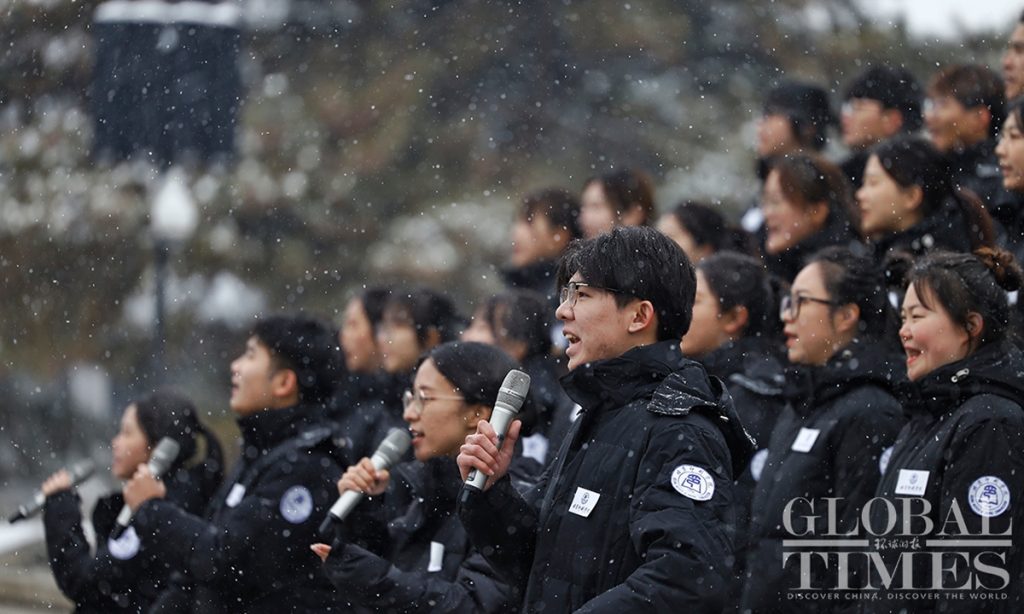
On December 13, the tenth national memorial day for the victims of the Nanjing Massacre, The Museum of the War of Chinese People's Resistance Against Japanese Aggression held a memorial ceremony to mourn the 300,000 victims of the Nanjing Massacre. University students and teachers in Beijing attended the ceremony, conveying their condolences. (Photo: Li Hao/GT)